

The hidden operational cost of running a $20M–$150M distribution business on Excel — and what changes when you stop.
A mid-market distributor running pricing and inventory through spreadsheets typically loses $250,000 to $1 million+ per year to delayed price updates alone — before counting 15–30 hours of weekly analyst time, margin erosion from inconsistent execution, and the single-point-of-failure risk of one person holding the logic in their head. This article breaks down exactly where the money goes, why "good enough" isn't, and what the distributors who've moved past spreadsheets are doing differently.
The Friday 3 PM problem
It's 3 PM on a Friday. Your biggest customer needs a quote by Monday. Your pricing manager is still buried in Excel, cross-referencing vendor cost files against the ERP and trying to remember which customer gets which tier.
This isn't a one-off. It's Tuesday. It's Wednesday. It's every week.
Across the distribution industry, operations leaders are watching their best people spend more time wrangling spreadsheets than running the business. The work never stops because the system never finishes. A new vendor price sheet lands in the inbox. A salesperson asks what to quote on a rush order. The sales manager wants a margin analysis by customer. Each question triggers another round of manual lookups, another file version, another chance for something to slip.
If that description lands too close to home, the rest of this article is for you.
Why spreadsheet-based pricing and inventory is a mid-market-specific problem
Spreadsheets work fine for small distributors. A $5 million operation with 500 SKUs and 50 customers can genuinely run pricing out of Excel.
The problem hits at the mid-market threshold — roughly $20 million in revenue, 5,000+ SKUs, and dozens of customer segments. At that scale, the permutations explode. Vendor cost changes arrive weekly. Sales reps need instant quotes. Margin slips in directions that aren't visible until the quarterly close. And the person holding it all together is, typically, one pricing analyst or operations manager running a stack of linked workbooks that nobody else fully understands.
This is the gap mid-market distributors fall into: too large for spreadsheets to scale, too small for enterprise pricing platforms like PROS or Vendavo that were built for $500 million+ companies.
What does manual pricing actually cost a distributor?
Direct answer: The cost shows up in four places — time, margin, errors, and risk. Based on Intuilize benchmark research across mid-market distributors:
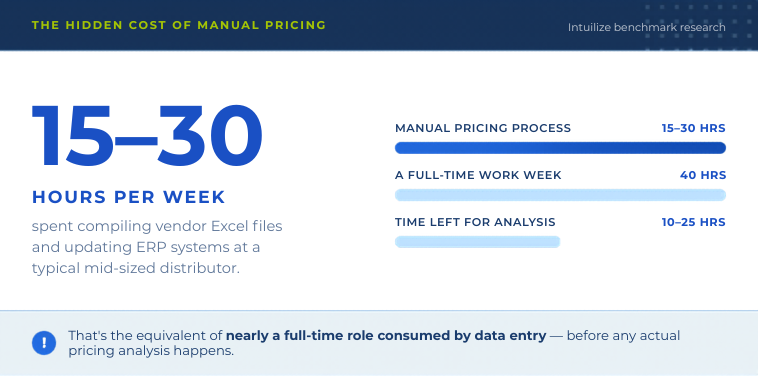
- 15–30 hours per week of analyst time spent compiling vendor Excel files and updating the ERP. That's the equivalent of nearly a full-time role, consumed by data entry.
- 1.6% average margin erosion from the lag between vendor cost increases and customer-facing price updates.
- 6.0% average margin erosion from weak execution when price changes finally do go through — inconsistent application, delayed rollout, missed SKUs.
- $250,000 in documented annual losses at a $45 million distributor from delayed pricing updates alone, affecting only 7% of the catalog. Over four years, the compounded loss exceeded $1M.
On top of that: inventory that sits too long, stockouts on high-margin SKUs, and the 695 "drain" customers one Intuilize client discovered were generating 24% of sales at only 30% gross margin — while just 3 "core" customers drove 27% of sales at 57% margin. None of that was visible in the spreadsheet.
What is the single biggest operational risk of spreadsheet-based pricing?
Direct answer: Tribal knowledge concentration — the fact that your entire pricing logic typically lives in the head of one long-tenured employee, with the spreadsheets serving as their working notebook rather than a shareable system.
An operations director at a mid-sized distributor put it in the starkest terms possible in research interviews: "The worst story anyone can imagine would be that your pricing costing guru dropped dead, but that actually happened. A lovely gentleman passed away suddenly and was the only person in the organization who knew how to do that stuff. The organization paid heavily for the data drifting way out of sync."
That's the extreme case. The more common case is quieter: a retirement, a resignation, a two-week vacation during which three vendor price changes pile up and nobody knows which customers are affected. The result is the same — pricing discipline collapses the moment the one person who understands it steps away.
For an operations leader, this is the single most expensive risk hiding in the current process. It's the risk that doesn't show up on a P&L until the day it does.
The four operational costs of "Excel hell"
Below the surface of every spreadsheet-based pricing process, there are four specific failure modes driving the financial losses:
1. Time Lag. Updates that should take days stretch into weeks or months. Vendor raises costs on Monday. Your customer-facing prices don't reflect it until the following month. Every order shipped in between hands margin back to the customer at no charge.
2. Error Risk. Manual data entry across thousands of SKUs guarantees mistakes. A mis-keyed decimal on one SKU in one customer tier can go unnoticed for a full quarter before anyone catches the bleed.
3. Resource Drain. Your most capable analyst — the one who should be identifying margin opportunities, not chasing data — spends the bulk of their week on data janitorial work. The cost isn't just their time; it's the strategic analysis that never happens because the clerical work never ends.
4. Knowledge Risk. The pricing rules aren't documented. They live in the analyst's memory, encoded across tab-referenced formulas that nobody else can parse. When that person leaves, the logic goes with them.
What does "automate or evacuate" actually mean?
Direct answer: It means the distributors keeping pace with market conditions have already stopped running pricing and inventory out of spreadsheets. The gap between them and competitors still on manual processes is widening every quarter.
The distributors who've moved past spreadsheets share three traits:
- Automated vendor cost pass-through. Price updates flow from vendor file → system → customer-facing prices in days, not weeks. The analyst reviews exceptions; the system handles the 95% of straightforward updates.
- Centralized, consistent pricing across branches and salespeople. The same customer gets the same price regardless of who quotes it. Margin variance by salesperson disappears.
- Real-time visibility into margin leaks. The system flags at-risk SKUs and customer relationships before they become quarterly surprises. Drain customers get identified. Underpriced SKUs get flagged.
As Intuilize CEO Nelson Valderrama puts it:
"We are not 'just' a technology company — we build a playbook with your team to capture tribal knowledge and put business rules in place so that everyone knows where a recommendation originated."
The playbook matters. Tools that replace spreadsheets without capturing the institutional knowledge behind them trade one problem for another. The goal isn't to automate away your pricing person — it's to stop trapping them in Excel so they can do the strategic work they were hired for.
What changes when a mid-market distributor moves off spreadsheets?
Concrete results from mid-market distributors who made the move:
- Mid-Market Janitorial Distributor ($10 million, 50,000+ SKUs): $93.6K gross margin lift in 4 months (1.2% margin improvement), 3.0X ROI, 99.5% pricing adoption rate. The operations manager had been personally involved in every pricing decision — an unsustainable bottleneck — before moving off spreadsheets.
- Industrial Distributor (85,000+ SKUs): $450K annual margin lift, $5 million in working capital freed, 7X ROI in 9 months, 1,200 hours of manual procurement work eliminated.
- Motor City Industrial: $500K margin lift, 10X+ ROI, 90%+ pricing adoption across the sales team.
- Industrial Controls Distributor (17,000+ SKUs, $32 million): $101.7K annual margin lift, 3.4X ROI in 8 months, 90%+ adoption.
None of these distributors hired a pricing team. None overhauled their ERP. The common pattern: systematize what used to live in spreadsheets and institutional memory, free the analyst's time, and let the operations leader run the business instead of running the pricing process.
How to know if your distribution business has hit the spreadsheet ceiling
Four diagnostic questions for operations leaders:
- How many hours per week does your pricing analyst spend on data entry versus analysis? If the answer is "mostly data entry," you've hit the ceiling.
- If your pricing analyst took a two-week vacation, what would break? If the answer is "pricing updates, quote turnaround, and margin reporting," you have a tribal knowledge problem.
- How long does it take to push a vendor cost increase through to customer prices? If the answer is measured in weeks rather than days, you're leaking margin every week.
- Can you see which customers and SKUs are underperforming on margin this month — not last quarter? If you have to wait for the quarterly close to find out, the spreadsheet is already too late.
Each of these questions maps to a specific, fixable operational gap.
What Happens Next Is Up To You
You call Excel your pricing system. It isn't. It's a $250,000-a-year tax on every decision your team makes too slowly — so the real question isn't whether it still works, but how much longer you can afford the version of "working" you have now.

Meet Our CEO
 Nelson Valderrama is the Founder and CEO of Intuilize.
With 30+ years in distribution and nearly a decade of developing and deploying Machine Learning models tailored specifically for distributors, he helps mid-market industrial distributors identify and eliminate margin leakage across pricing, costs, and inventory — and keep it fixed. He built Intuilize on the premise that software alone doesn't earn trust and expertise alone doesn't scale: distributors need both a model built for their business and someone who knows distribution well enough to drive adoption and deliver real ROI
Contact: nelson@intuilize.com | LinkedIn