


December's decisions show up in your January P&Ls. Is dead stock tying up working capital? Are orders shipping at old prices while you process vendor increases? Your January numbers reveal what you didn't address in Q4; the discipline ignored during year-end becomes the profitability problem bleeding into your first quarter.
December’s choices always have a way of showing up in your January numbers. Whether it’s dead stock eating your capital or orders shipping at last year's prices while you're still processing vendor increases, your January P&L doesn't lie. It reveals exactly what you ignored during the Q4 rush.

The "we’ll deal with it later" mindset from year-end is officially bleeding into your new year’s profits.
These aren't just one-off bad breaks; they are structural "profitability constraints" that systematically drain your margins.
Every distributor has them. The trick lies in diagnosing which one is currently hitting your wallet the hardest.
Four Profitability Constraints
I’ve spent thirty years working with industrial distributors and I see the same patterns over and over. When a company's profits are suffering, it almost always comes down to the same handful of core problems—usually just four profitability constraints.
To fix your bottom line, stop playing Whac-A-Mole with symptoms and tackle the primary hurdle.
The Margin Gap
The symptoms show up everywhere:
- inconsistent pricing across your sales team,
- slow response to vendor cost changes,
- manual processes that just can't keep pace with market dynamics.
Here's a simple diagnostic test. Pull quotes from your top five salespeople for a quote on the same product going to similar customers. You’ll probably see 10-20% variance in pricing. That inconsistency isn't just a quirk—it’s a structural flaw that can quietly erode your margins by 2-5%.
The Cash Flow Gap
Excess inventory traps your working capital. High-margin items face stockouts. Static min/max levels go for years without review. Does any of this sound familiar?
When your cash is stuck in dust-collecting inventory while your bestsellers are constantly out of stock, it’s not just about "bad inventory." January's P&L may reveal a cash flow gap — it’s about millions of dollars that could grow your business sitting on a shelf.
The Vulnerability Gap
If it takes your team 40 hours to update prices across your system, you’re vulnerable. While you manually crunch numbers, orders ship at old prices, losing money on every sale. Your automated competitors can do this in two hours. This gap doesn't just cost money; it kills your confidence to respond to the market.
The Scalability Gap
If your distributorship can’t run without a handful of "hero" employees, you have a scalability gap. Growth shouldn't mean you have to hire more people just to keep up. It should mean more leverage. If every new customer creates a massive operational headache, your structure is the problem.
Growth should create leverage, not just bigger operational challenges. When it doesn't, the scalability gap is your profitability constraint.
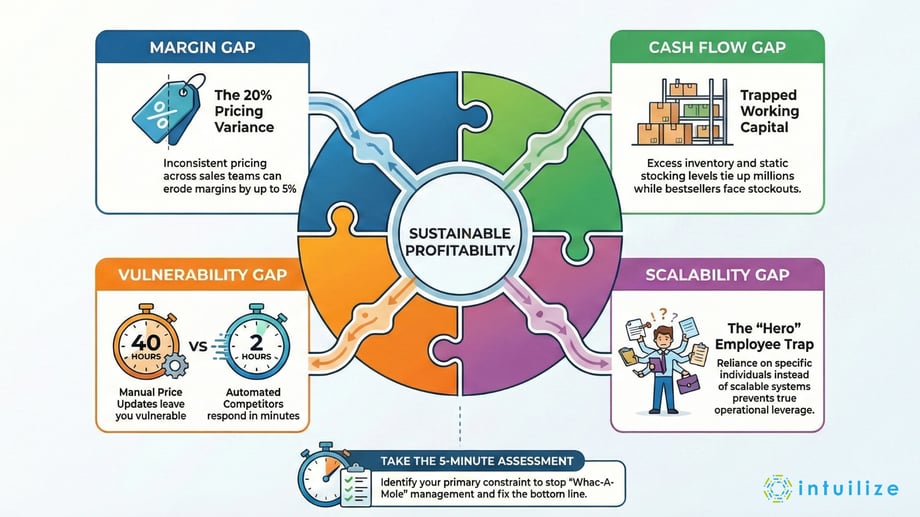
Most distributors suffer with at least two of these profitability constraints.
We built a five-minute test to help you identify your primary issue. Take the Assessment today to see which constraint is actually costing you the most. Take the Assessment!
The Profitability Constraint Syndrome
These constraints don’t live in a vacuum—they feed off each other. A vulnerability gap (slow updates) leads to a margin gap (wrong prices). That drains your cash, leading to a cash flow gap (bad inventory). Then, trying to manage all that chaos manually creates a scalability gap. To stop the cycle, knock down the first domino.
Take the 5-Minute Assessment to see how these gaps are connecting in your business and get a custom game plan.
The Cost of Pricing Misdiagnosis
Misdiagnosis means spending 6-12 months working on the wrong thing while the real constraint keeps bleeding profit. The opportunity cost isn't just the margin you're losing today—it's all the improvements you could have made if you'd started addressing the real constraint sooner.
➡️ Motor City Industrial, a $16.4M industrial parts distributor, faced multiple profitability challenges in a highly competitive market.
Their pricing strategies lacked data-backed decision-making and relied heavily on tribal knowledge. This legacy manual pricing was inefficient, leading to errors and missed profit opportunities.
Motor City’s data-driven CEO Joe Stephens said, “I used to think I could do it all on my own.” We needed more than just a tactical solution; we needed a strategic approach to pricing. We went from relying on gut feelings to using metrics-driven insights.
Intuilize’s AI-powered pricing optimization helped the distributors achieve $545,000 in gross margin lift and over 10X ROI within 12 months by implementing Intuilize's AI-powered pricing optimization. Employee pricing adoption increased from 25% to over 90%, eliminating reliance on gut-feel decisions and transforming pricing chaos across 26,000+ SKUs into systematic profit.
➡️ An industrial distributor thought they needed inventory software.
However, they also needed to free up working capital, improve gross margins, and reduce manual labor while maintaining their high service standards and market competitiveness.
The lack of data-driven pricing strategies was causing significant revenue leakage, with an estimated $800,000 in lost gross margin annually due to inconsistent and suboptimal pricing decisions across their 85,000+ SKU catalog.
A Price Optimization Module helped implement dynamic pricing models based on customer behavior and historical trends, establishing volume-based discounts, and integrating automated price updates with their existing ERP system. They added an Inventory Optimization Module to deploy advanced demand forecasting for optimal stock levels and streamline requisition worksheet processes.
The distributor realized $450K in additional gross margin in the first 9 months of experience and 7X ROI in the first 12 months. That paid for the company’s investment seven times over.
Your January P&L Is Telling You Something
Your January numbers are talking—are you listening?
Things like low margins or slow inventory turns are usually just symptoms of these deeper issues. The longer you wait to fix them, the more they cost you in both lost profit and missed opportunities.
We’ve never worked with a distributor who didn't have at least one hidden constraint holding them back. Once you identify the big one, you can usually see actual results in 60 days. The patterns are already there in your data; we just help you spot them.
Take the Assessment to find your primary constraint, or book a 30-minute chat with us to dive into the details.
Don't let next January's P&L be a repeat of this one.
Nelson Valderrama is the Founder and CEO of Intuilize, helping mid-market industrial distributors recover 3–5% in lost margin and release 15–20% of trapped working capital by fixing the decision breakdowns that emerge at scale. He has pioneered AI-driven pricing and inventory optimization, providing decision-makers with accurate, visible and real-time-ready data.