


Manual pricing processes cost distributors $100K-$500K annually through hidden inefficiencies, consuming 30% of team time while competitors gain systematic advantages. Three critical cost capture points reveal where margins disappear.
Distributors are losing real money through reactive pricing approaches that treat symptoms, not causes.
The Confession That Started Everything
"That's all I live in are spreadsheets. I've done four vendor price updates this week alone, and I have no idea if we're making money on half our orders."
That's the confession of a pricing manager at a $35M industrial distributor. He wasn't complaining about his workload—he was describing the reality that millions of distribution professionals face every day.
The conversation continued:
"We have reports that are basically history lessons after something ships. Whoops. My best people spend 25-30 hours per week just managing pricing updates instead of strategic work."
Sound familiar? If you're reading this, chances are you've lived some version of this story. The endless spreadsheets, the reactive firefighting, the nagging suspicion that somewhere in your pricing process, money is walking out the door.
Here's what that confession taught us:
Manual pricing isn't just inefficient—it's systematically destroying distributor margins at a scale most companies never realize.
Traditional distributors face a harsh reality:
AI-enabled competitors aren't just more efficient—they're fundamentally restructuring competitive advantage.
Motor City Industrial's AI transformation delivered $500,000+ in gross margin lift with 10X ROI. Another distributor achieved $450,000 in additional margins while reducing manual tasks by 80%.
Read the full Case Study here.
The Three Critical Cost Capture Points
After analyzing hundreds of distributor pricing processes, we've identified where the money actually disappears:
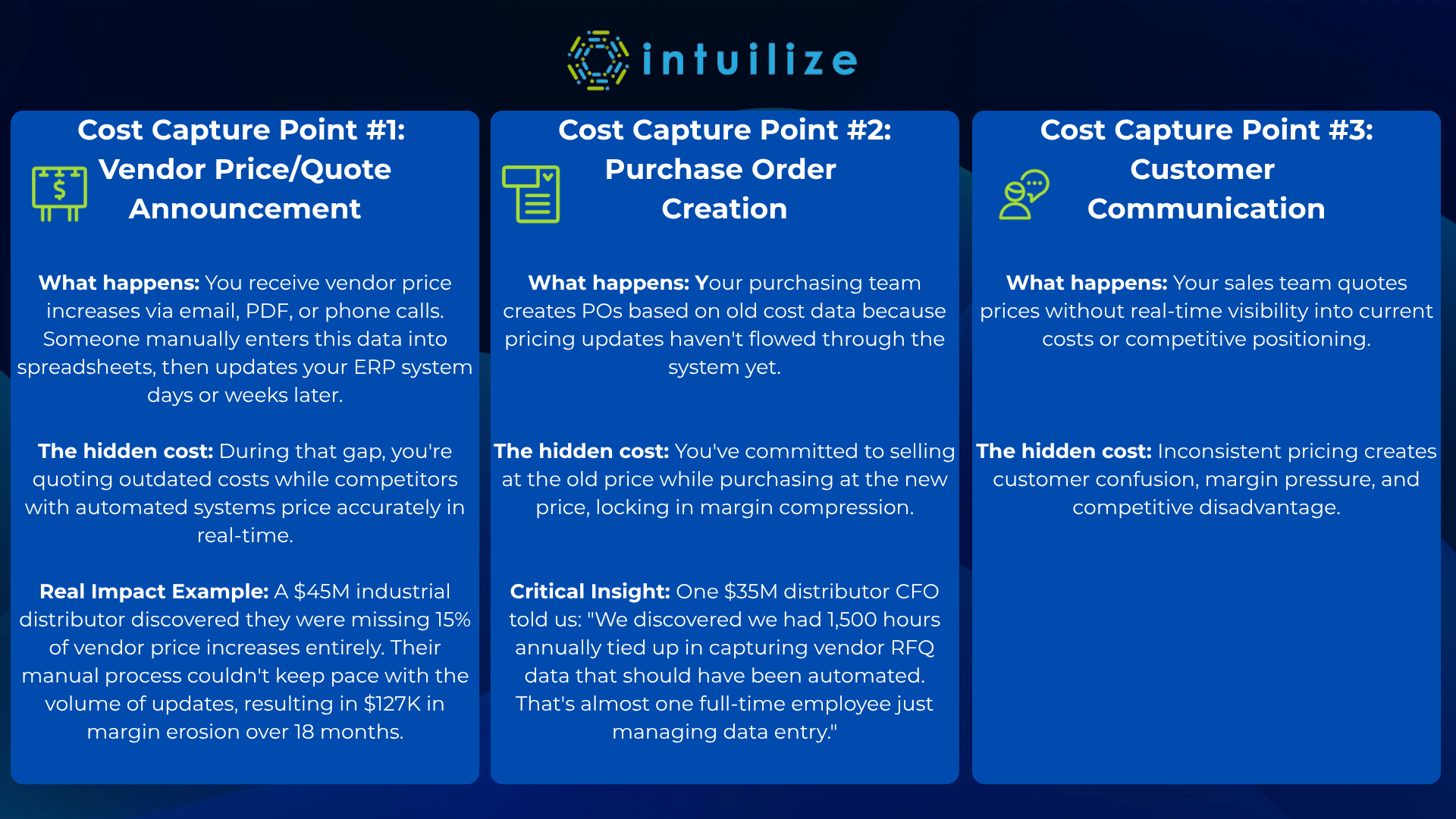
The Transformation Case Study: From Chaos to Control
Consider the journey of a $45M Industrial Parts Distributor who decided to confront their pricing reality:
Before Transformation:
-
Manual price updates taking 25-30 hours per week
-
Reactive pricing based on "gut feel" and competitor matching
-
No visibility into pricing performance until after orders shipped
The Turning Point: The CFO commissioned an audit of their pricing process and discovered something shocking: They had $1.7 million in potential margin optimization sitting right in their existing customer data.
"The lack of data-driven pricing strategies was causing significant revenue leakage, with an estimated $500,000 in lost gross margin annually," he explained.
After Systematic Implementation:
-
93% adoption rate among sales and operations teams
-
$120K margin improvement in the first four months
-
Real-time pricing intelligence integrated with their Prophet21 ERP
-
Team alignment around strategic pricing rather than reactive adjustments
The CFO's perspective:
"What we learned is that pricing transformation isn't about technology—it's about building systematic capability. The ROI was immediate, but the competitive advantage is permanent."
Calculate Your Hidden Revenue Leak
Want to estimate your own exposure? Use this framework:
Annual Revenue Leak Calculator:
- Manual Processing Hours: (Hours per week spent on pricing updates) × 52 × $75/hour
- Margin Compression: (Percentage of orders with pricing delays) × 2% margin impact × Annual Revenue
- Opportunity Cost: (Time spent on reactive pricing) × (Strategic initiative value)
Example for $50M Distributor:
- Manual processing: 25 hours/week × 52 × $75 = $97,500
- Margin compression: 15% of orders × 2% × $50M = $150,000
- Lost strategic focus: Estimated $100,000-250,000
Total Hidden Cost Range: $347,500-$497,500 annually
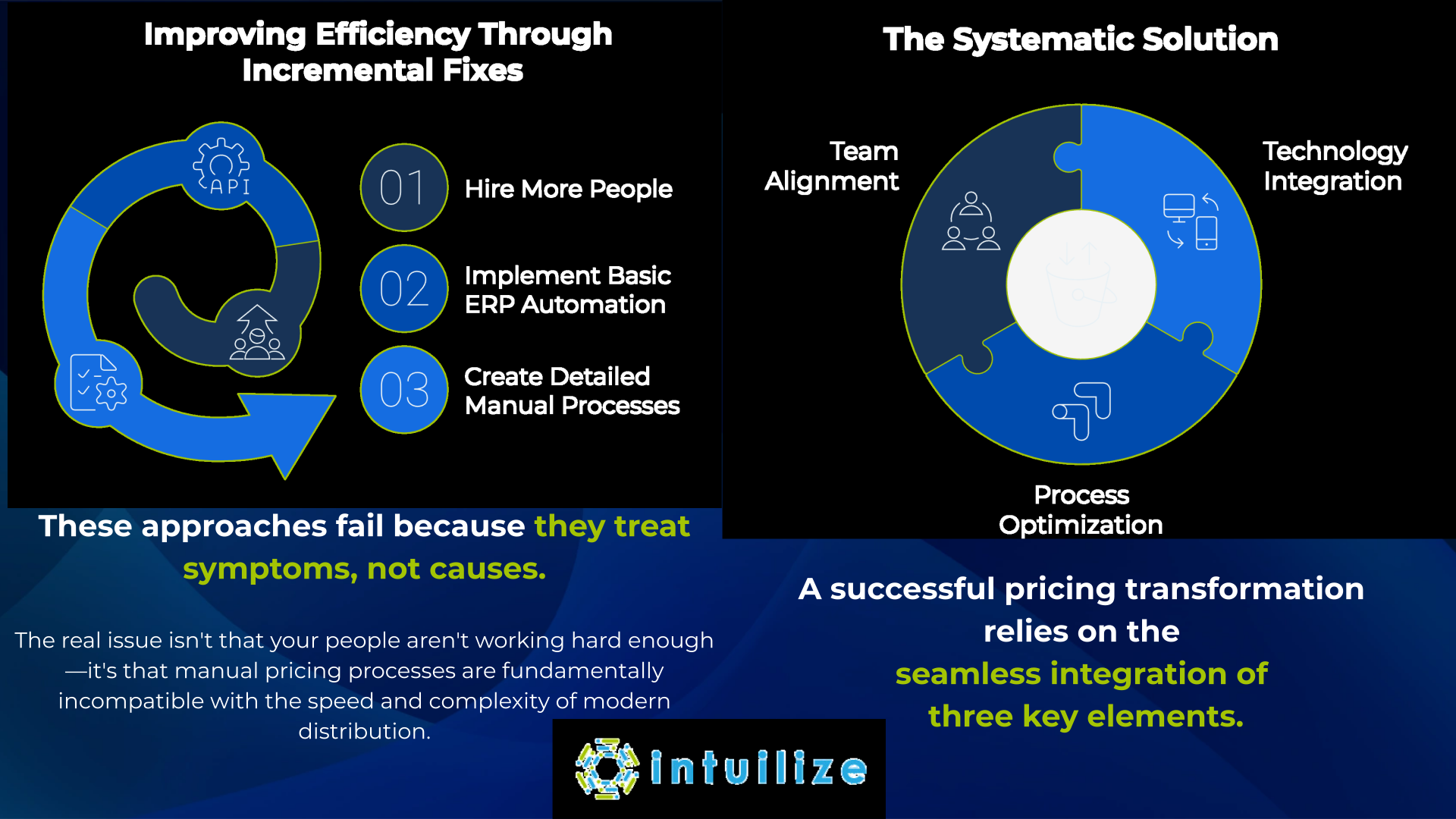
Beyond the Symptoms: Why Band-Aid Solutions Fail
From Recognition to Action
The confession that started this article—"That's all I live in are spreadsheets"—doesn't have to be your reality.
The distributors who've transformed their pricing approach share three characteristics:
- They recognized that manual processes were systematically destroying value
- They committed to systematic solutions rather than incremental fixes
- They partnered with specialists who understood both the technology and the change management required
What Happens Next Is Up To You
Are you ready to stop living in spreadsheets and start building the systematic pricing capability that turns hidden costs into competitive advantage?

Meet Our CEO
 Nelson Valderrama is the Founder and CEO of Intuilize.
With 30+ years in distribution and nearly a decade of developing and deploying Machine Learning models tailored specifically for distributors, he helps mid-market industrial distributors identify and eliminate margin leakage across pricing, costs, and inventory — and keep it fixed. He built Intuilize on the premise that software alone doesn't earn trust and expertise alone doesn't scale: distributors need both a model built for their business and someone who knows distribution well enough to drive adoption and deliver real ROI
Contact: nelson@intuilize.com | LinkedIn