
.png)
A CEO recently told me his company is sitting on $5 million in excess inventory while customers face stock-outs on critical items.
After 30 years in distribution, I've watched this pattern repeat hundreds of times. The inventory problems that seemed manageable are becoming critical vulnerabilities for 2026.
Supply chain volatility isn't going away. Distributors who optimize now won't be scrambling when the next disruption hits.
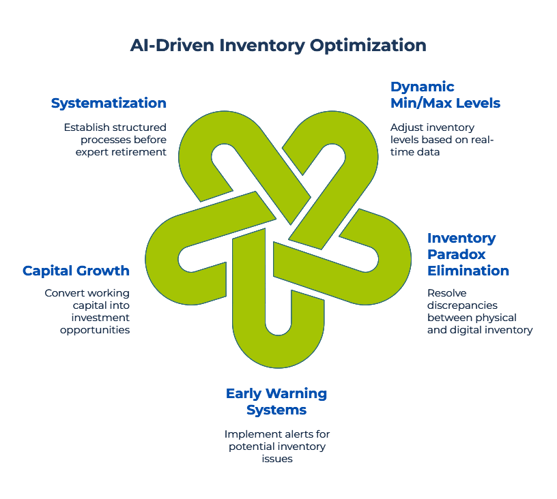
1. Stop treating Min/Max levels as "Set it and Forget it"
Most warehouses have inventory levels set three years ago that haven't been touched since.
The problem:
- Summer SKUs stocked at winter levels in November
- Fast-movers run out while slow movers gather dust
- Spreadsheet formulas from 2021 can't predict 2024 demand
The fix: Market-adaptive forecasting analyzes historical patterns, seasonality, and customer behaviors in real time—adjusting continuously as conditions change.
Result: One distributor freed $5 million in working capital within nine months by stocking smarter, not by cutting service levels.
2. Eliminate the inventory paradox
Too much of what doesn't sell. Not enough of what customers want.
What this costs:
- Stock-outs damage trust—customers eventually stop calling
- Excess inventory ties up cash that could fund growth
- Most distributors can't see inventory holistically across locations
The solution: Multi-location intelligence provides real-time visibility across all warehouses. Everyone works from the same data.
Result: 95% team adoption within six months because the system made jobs easier, not harder.
3. Build early warning systems
Manual inventory management is reactive. You discover problems when customers call asking for something you don't have.
How AI-powered early warnings work:
- Demand trending up? Alert before you run out
- Supplier showing delays? System adjusts reorder points automatically
- High-margin items get tighter controls and earlier warnings
Result: One distributor reduced emergency orders by 80%, saving $48,000 annually in labor costs—plus eliminated rush shipments and premium supplier pricing.
4. Turn working capital into Growth Capital
For a $50 million distributor, freeing 15% of working capital means $750,000 to $3 million available for strategic initiatives.
The fear: Cut inventory too aggressively and you create stock-outs that damage customer relationships.
AI-powered optimization:
- Identifies which inventory is truly excess vs. needed for service
- Optimizes reorder points based on actual demand patterns
- Balances working capital efficiency with customer service
Documented results:
- 15-20% of working capital freed in first year
- Service levels maintained or improved
- One customer reduced carrying costs 20% while improving fill rates
Key insight: You don't need excess inventory to maintain service levels. You need the right inventory.
5. Systematize before your inventory expert retires
When your top procurement person leaves, what happens to their knowledge about vendor lead times, seasonal patterns, and customer buying behaviors?
AI captures institutional knowledge permanently:
- Demand patterns, seasonal trends, supplier reliability
- System learns from every transaction
- Knowledge becomes a company asset, not person-dependent
Real example: One distributor's inventory manager left unexpectedly during implementation. The transition was smooth because the new person had access to all decision logic and historical patterns.
What this looks like in practice
An industrial parts distributor with 85,000+ SKUs implemented AI-powered pricing and inventory optimization nine months ago.
Before:
- 1,500 hours annually creating manual purchase orders
- $5 million+ tied up in excess stock
- Frequent stock-outs frustrating customers
After nine months:
- $450,000 additional gross margin generated
- 7X ROI first year
- 80% reduction in manual procurement tasks
- 95% adoption rate
- Working capital freed for growth
This happens when you optimize before you need to, not when crisis forces your hand.
The window that's closing
Market volatility is the new normal. Distributors who optimize now will capitalize on 2026's disruptions with systems that adapt in real time.
Those who wait will implement under pressure—with fewer resources, less time, more risk.
Your inventory is either working for you or against you. There's no middle ground.
💡 The question: Will you build resilience before the next crisis hits, or implement when it's too late?

About the Author:
Nelson Valderrama brings 29+ years of distribution experience to pricing and inventory optimization. He's worked with over 100 mid-market distributors to implement systematic pricing processes that drive measurable margin improvement.