

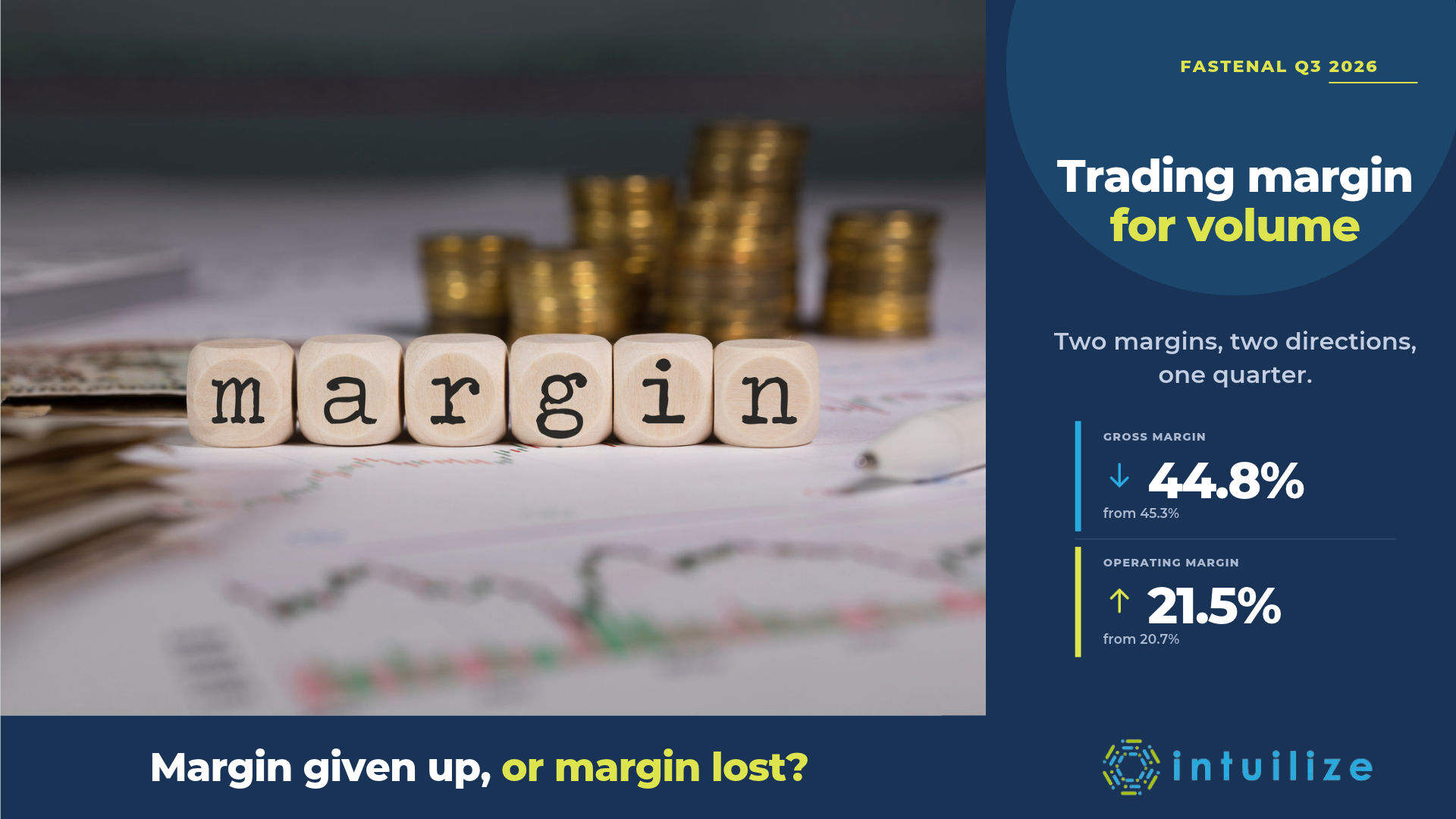
Fastenal's third-quarter net sales rose 15.5% to $2.46 billion, according to its October 14 earnings release. Its operating margin climbed to 21.5%, from 20.7%. Its gross margin slipped to 44.8%, from 45.3%.
Two margins, two directions, one quarter. Fastenal's own release explains why, in basis points.
What Fastenal's Release Shows
The release splits the gross margin move into parts. A continued shift toward larger customers cost about 50 basis points. Price/cost cost about 30 more. Direct sourcing savings, supplier rebates, and tariff refunds pushed the other way, and about 20 basis points of that benefit reflected favorable timing.
Lower in the income statement, SG&A (Selling, General, and Administrative expenses) fell to 23.3% of sales, from 24.6%. That is what lifted operating margin.
Fastenal's position is that larger customers carry lower gross margins but are "accretive to operating margin," because they bring in more profit dollars and spread fixed costs across more volume. Given its numbers, that holds up.
Why the Trade Works for Fastenal
It works because Fastenal can see it. The release names price/cost, customer mix, sourcing savings, and timing, each with its own number. That's a decomposition: margin broken into the forces behind it, instead of one blended figure.
The trade also rests on Fastenal's cost structure. A 130 basis point drop in SG&A as a share of sales is what makes lower gross margin on larger customers pay off. Whether the same trade pays at your distributor depends on your SG&A, your cost to serve, and the price each large account got.
Margin Given Up Versus Margin Lost
A larger customer can end up at a lower gross margin for two reasons. You priced it that way on purpose, for the volume and the scale. Or the price drifted there, deal by deal, and nobody decided it.
Both land in the same blended number. Only one of them is a trade.
That's the part of the volume-or-margin debate that rarely gets tested. If part of your gross margin decline is a decision, you can defend it, the way Fastenal does. If part of it is drift, that part was never a trade. Having both volume and margin starts with knowing which is which.
Sources: Fastenal Company, "Fastenal Company Reports 2026 Third Quarter Earnings," Form 8-K, Exhibit 99.1, October 14, 2026 (SEC EDGAR); Industrial Distribution's report of the same day (Fastenal's Q3 Sales Climb 15.5%).
What Happens Next Is Up To You
Separating the two is what our Margin Diagnostic does: two weeks, your own transaction data, and a specific dollar figure on what the pattern is costing. It typically finds 1.4% to 3.7% of annual revenue in pricing, costs, and inventory decisions. The diagnostic identifies where the margin is leaking. Recovery depends on which recommendations you act on.

Meet Our CEO
 Nelson Valderrama is the Founder and CEO of Intuilize.
With 30+ years in distribution and nearly a decade of developing and deploying Machine Learning models tailored specifically for distributors, he helps mid-market industrial distributors identify and eliminate margin leakage across pricing, costs, and inventory — and keep it fixed. He built Intuilize on the premise that software alone doesn't earn trust and expertise alone doesn't scale: distributors need both a model built for their business and someone who knows distribution well enough to drive adoption and deliver real ROI
Contact: nelson@intuilize.com | LinkedIn